
Bulk Dehydrated Garlic Sourcing Guide for Food Manufacturers
Executive answer: Food manufacturers sourcing bulk dehydrated garlic should evaluate more than price. The right supplier must provide consistent garlic form, reliable flavor profile, controlled moisture, practical packaging, export documentation, and clear communication from sample approval to shipment. Fresh Time Foods supplies dehydrated garlic and related dehydrated vegetable ingredients for industrial food production, OEM projects, private label programs, and bulk export buyers.
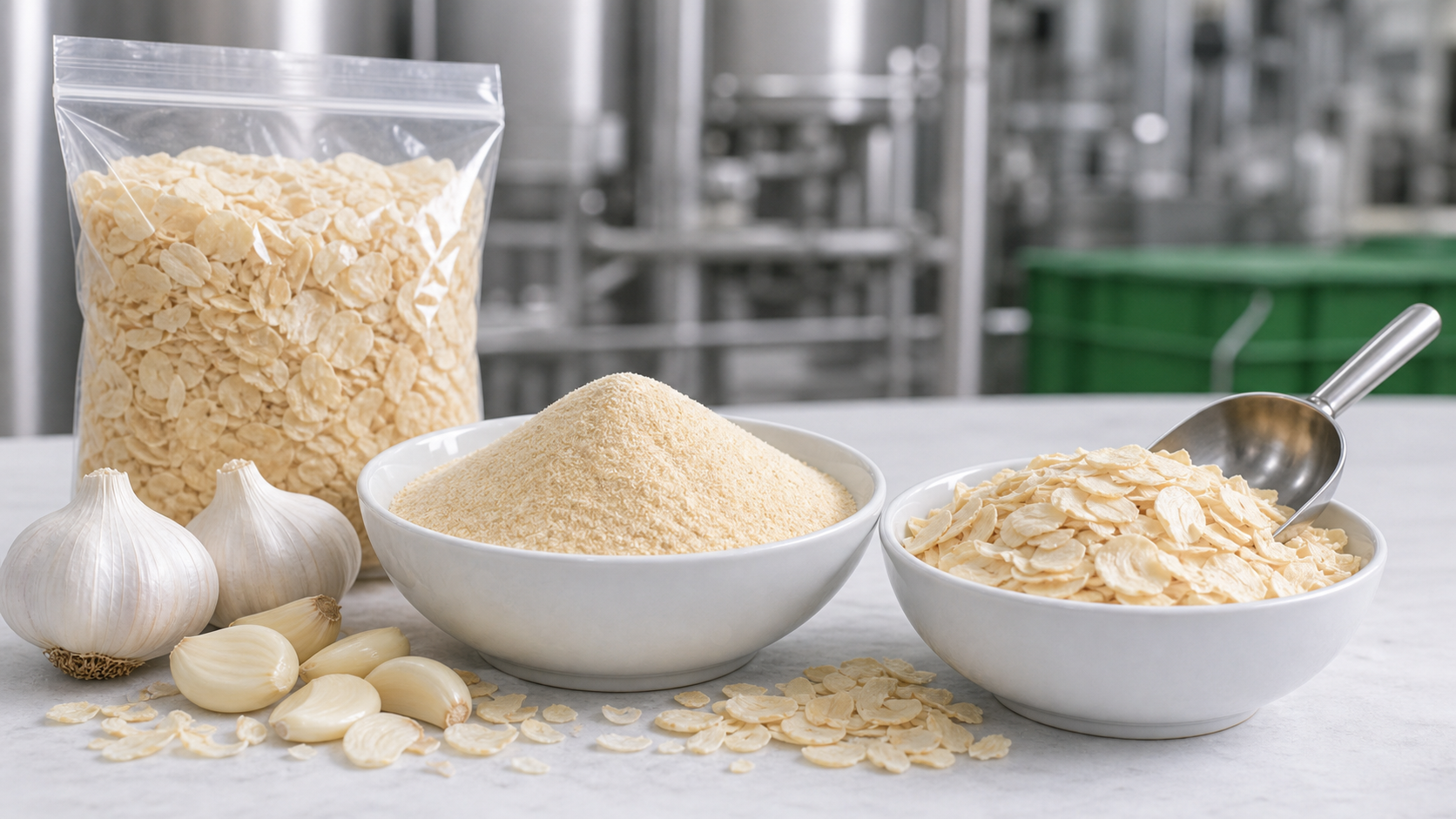
Dehydrated garlic is widely used in seasoning blends, sauces, soups, snacks, meat alternatives, ready meals, marinades, bakery fillings, and dry-mix applications. It offers concentrated garlic character, easier storage than fresh garlic, and practical handling for factories that need repeatable ingredient performance. But bulk purchasing requires a disciplined evaluation process because different forms of dehydrated garlic behave differently in production.
Why Bulk Buyers Source Dehydrated Garlic
For procurement teams, dehydrated garlic can reduce preparation work, simplify inventory management, and support consistent flavor delivery across large production runs. It also helps manufacturers avoid the handling variability that can come with fresh garlic, especially when production schedules require stable year-round supply.
The strongest sourcing programs start with application needs. A snack seasoning producer may need powder that disperses evenly. A soup manufacturer may prefer flakes or granules that rehydrate with a visible ingredient identity. A sauce or marinade producer may care about flavor release, color, particle size, and how the ingredient behaves during mixing or heat processing.
Garlic Powder, Flakes, Granules, and Minced Garlic
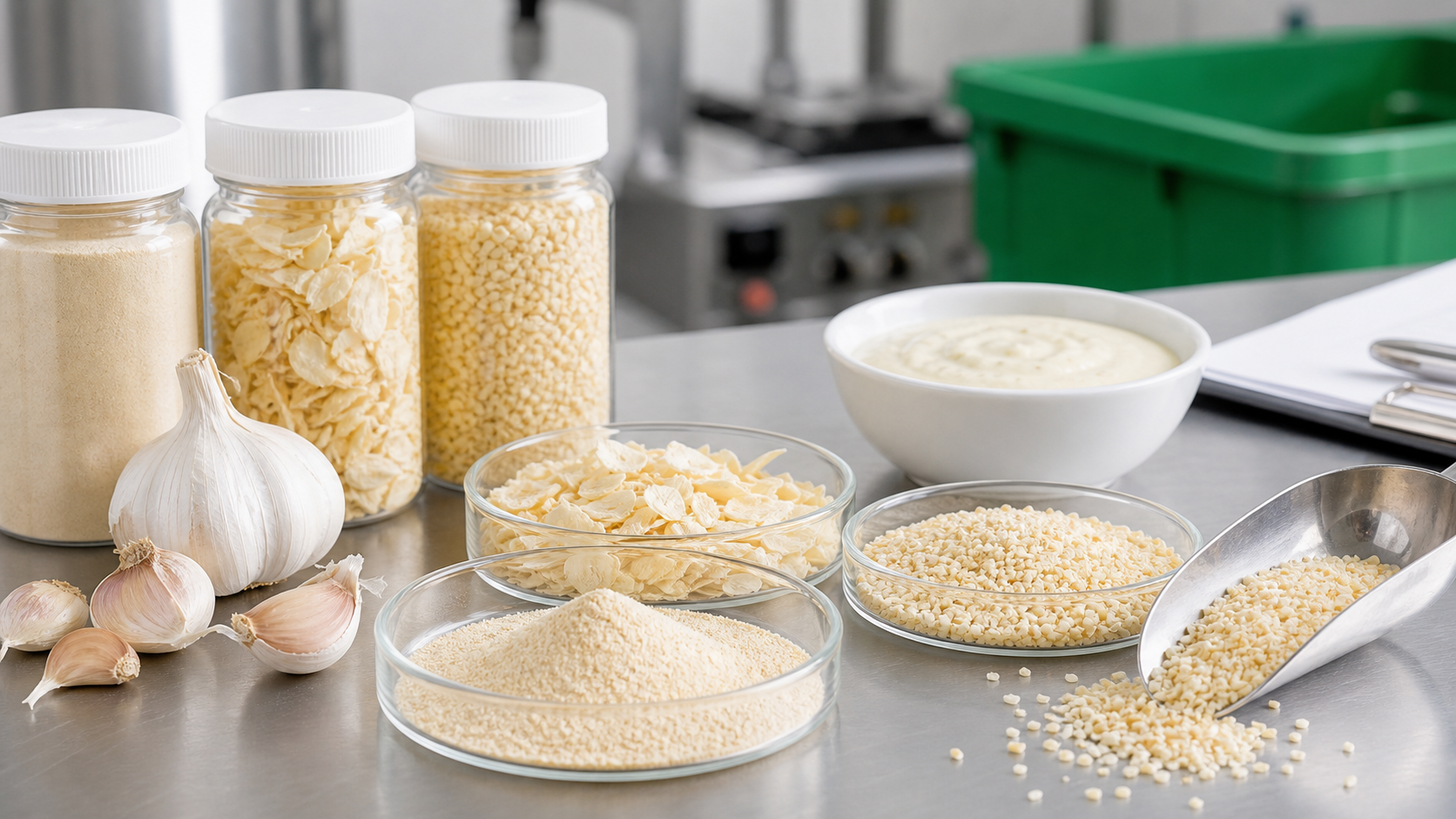
Bulk dehydrated garlic is not one product. Buyers should first choose the right form for the finished application. Powder is often selected for seasoning systems, sauce bases, dry rubs, and snack coatings because it distributes quickly and provides uniform flavor. Flakes are useful when the finished product needs visible garlic pieces or a more natural ingredient appearance. Granules and minced garlic can offer a balance between visibility, texture, and distribution.
Garlic powder: best for dry blends, sauces, seasonings, snack coatings, and fast flavor dispersion.
Garlic flakes: useful for soups, ready meals, noodle cups, and applications where visual pieces matter.
Garlic granules: practical for controlled distribution in dry mixes and prepared foods.
Minced or chopped garlic: useful when buyers want more visible texture than powder but smaller pieces than flakes.
Fresh Time Foods can discuss the right garlic form based on application, packaging format, and export requirements. Buyers working with multiple ingredients may also review complementary options such as dehydrated white onions or customized vegetable blends.
Specifications That Should Be Clear Before Quotation
A professional quotation request should define the product clearly. If a buyer asks only for “garlic powder” or “dried garlic,” suppliers may quote different particle sizes, moisture ranges, grades, packaging formats, and documentation assumptions. This makes price comparison unreliable.
Required garlic form: powder, flakes, granules, minced, chopped, or custom cut.
Target application: seasoning, sauce, soup, snack coating, ready meal, marinade, or industrial processing.
Particle size, mesh, or cut-size tolerance.
Moisture expectation, color preference, aroma profile, and visual quality expectations.
Packaging format, carton weight, inner bag requirement, palletization, and private label needs.
Destination market and export documentation requirements.
Expected annual volume, shipment schedule, and sample approval process.
Supplier Evaluation Criteria for Purchasing Managers
A reliable dehydrated garlic supplier should be evaluated through manufacturing control, documentation readiness, communication quality, and ability to support repeat orders. Industrial buyers need suppliers that understand procurement requirements, not only product descriptions. If the ingredient is used in a customer-facing food product, a late shipment or inconsistent batch can affect production planning and customer approval.
Buyers should ask how the supplier manages drying, sorting, inspection, packing, and traceability. Fresh Time Foods explains more about its production approach on the process page. For broader sourcing strategy, buyers can also review our guide on sourcing dehydrated vegetables from China.
How to Compare Samples Before Bulk Approval
Sample evaluation should be practical and production-oriented. A small sample should be checked for appearance, aroma, particle size, flow, rehydration behavior if relevant, and performance in the buyer’s real application. For powder, buyers may test dispersion in dry blends, sauces, or seasoning systems. For flakes or granules, they may check visual consistency, breakage, rehydration appearance, and how the ingredient behaves during mixing or filling.
It is also useful to compare samples against the intended packaging and storage conditions. An ingredient that looks good in a sample pouch may behave differently in bulk cartons, long-distance transport, or humid handling environments. This is why buyers should confirm packaging assumptions, inner bag materials, carton weight, and storage guidance before moving from sample approval to purchase order.
Packaging, Shelf Life, and Storage Considerations
Packaging is not just a logistics detail. For dehydrated garlic powder, packaging can affect flowability, caking risk, aroma protection, and warehouse handling. For flakes and granules, packaging should help protect visual integrity and reduce avoidable breakage. Buyers should discuss carton size, inner liners, pallet configuration, container loading, and whether the destination warehouse has any special handling requirements.
Storage recommendations should be aligned with the buyer’s quality system. Dehydrated garlic is typically handled as a dry ingredient, so protection from moisture, strong odors, direct sunlight, and excessive heat is important. Purchasing teams should ask suppliers to state recommended storage conditions clearly and should make sure the receiving warehouse can follow them.
Food Safety and Documentation for Import Programs
Food manufacturers and importers should confirm required documentation before order confirmation. Typical discussions may include product specification, packing details, ingredient declaration, allergen information, storage recommendation, certificate of analysis where available, commercial invoice, packing list, and other export documents required for the destination market.
The exact documentation package depends on buyer policy, destination country, and application. Large food manufacturers, supermarket supply chains, and private label programs often need more structured approval than smaller spot purchases. Strong suppliers are prepared to discuss these requirements early so the buyer does not discover missing documents near shipment.
Cost Optimization: Look Beyond the Unit Price
The lowest quoted price is not always the lowest sourcing cost. A cheaper powder that cakes, flows poorly, or does not disperse evenly can create production waste. A low-cost flake with high breakage may fail visual standards in soups or ready meals. A supplier that communicates clearly, matches the specification, and supports stable repeat production can reduce hidden costs even when the first quote is not the lowest.
Buyers should compare price together with usable yield, packaging performance, production fit, documentation quality, lead time reliability, and supplier responsiveness. This is especially important for bulk garlic powder and dehydrated garlic flakes because handling characteristics can affect factory efficiency.
OEM and Private Label Purchasing Considerations
For OEM and private label programs, the sourcing conversation should include packaging, labeling, carton marks, documentation, artwork timing, and whether the garlic product is purchased alone or as part of a broader ingredient program. Fresh Time Foods can discuss customized dehydrated vegetable solutions for buyers developing branded products, retail-ready dry mixes, or industrial ingredient programs.
If your team is comparing garlic with other dehydrated vegetables, our recent dehydrated onion supplier guide may also help define supplier evaluation criteria that apply across multiple ingredients.
FAQ: Bulk Dehydrated Garlic Sourcing
What is the best form of dehydrated garlic for seasoning blends?
Garlic powder is usually the most practical form for seasoning blends because it disperses evenly and supports consistent flavor distribution. Granules may be useful when the formula needs more texture or controlled visual presence.
What should buyers include in a bulk garlic powder inquiry?
Buyers should include particle size or mesh, application, packaging format, destination market, estimated volume, documentation needs, and any moisture, color, aroma, or microbiological expectations.
Can dehydrated garlic be used for OEM or private label products?
Yes. Dehydrated garlic can be used in private label seasonings, soup mixes, snack coatings, sauces, marinades, and ready-meal ingredients. Packaging and documentation should be discussed early.
How can importers reduce sourcing risk?
Importers can reduce risk by defining specifications clearly, confirming documentation before order placement, evaluating supplier communication, requesting appropriate samples, and working with a supplier that understands export requirements.
Request Bulk Dehydrated Garlic Specifications
Practical Next Steps for Procurement Teams
Before approving a bulk dehydrated garlic supplier, procurement teams should align internally with quality assurance, product development, warehouse operations, and logistics. The purchasing team may focus on price and lead time, but the technical team may need particle size, flavor performance, microbiological limits, and documentation. The warehouse team may care about carton weight, pallet dimensions, and storage conditions. Bringing these requirements together before requesting a quotation helps prevent delays and makes supplier comparison more accurate.
A strong inquiry should also explain the commercial context: whether the garlic ingredient is for an existing product, a new formulation, an OEM project, a private label program, or a long-term distribution plan. That context helps Fresh Time Foods recommend the right dehydrated garlic form and discuss related ingredients when needed.
If you are sourcing dehydrated garlic powder, flakes, granules, or customized garlic ingredients for food manufacturing, distribution, OEM, or private label programs, contact Fresh Time Foods to discuss samples, specifications, packaging, documentation, and bulk export requirements. You can also explore more articles on the Fresh Time Foods blog.


Comments